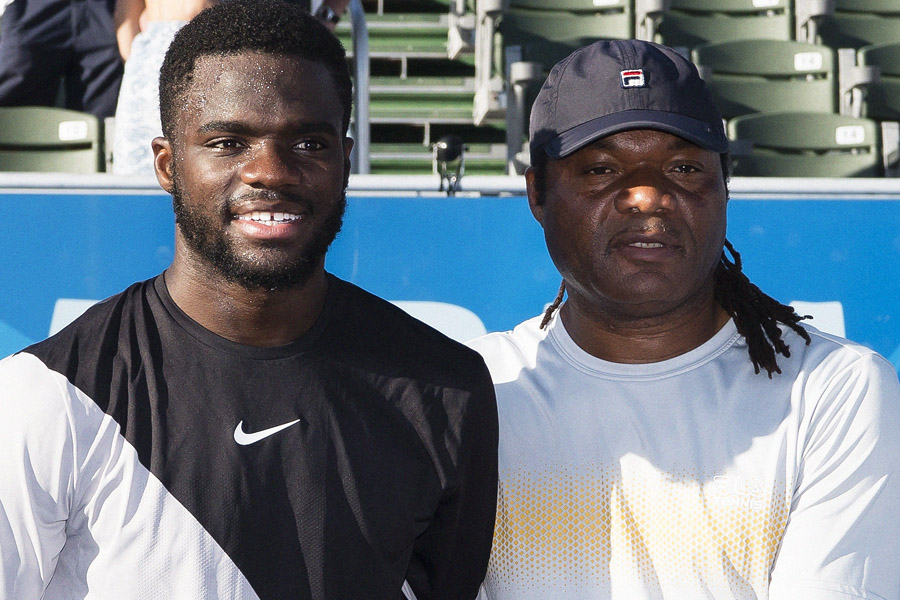
Basic Information
| Field | Details |
|---|---|
| Full Name | Constant Tiafoe (often referred to as Frances Tiafoe Sr.) |
| Also Known As | Constant Zubairu; “Frances” in some early records |
| Birthplace | Sierra Leone (date not publicly disclosed) |
| Nationality | Sierra Leonean-born; long-time U.S. resident |
| Immigration Timeline | 1988: emigrated to the UK; 1993: settled in Maryland, USA |
| Partner/Spouse | Alphina Kamara (married 2013) |
| Children | Twins: Frances (“Francis”) Tiafoe Jr. (b. 1998); Franklin Tiafoe (b. 1998) |
| Occupations | Day laborer and construction worker (JTCC build, 1999); maintenance manager/custodian at JTCC (2000s); small business attempt (2014); car wash worker (Hyattsville, MD) |
| Known For | Father of pro tennis star Frances Tiafoe; enabling his sons’ access to elite training |
| Residence | Maryland, USA |
| Financial Profile | No public net-worth estimate; described as modest, working-class |
| Public Image | Hard‑working immigrant father; no known controversies |
| Social Media | Limited to none; occasional appearances via family posts |
Biography & Early Life
Constant Tiafoe’s narrative begins in Sierra Leone and spans two continents before arriving in America. He moved from Sierra Leone to the UK in 1988 and subsequently to Maryland in 1993 to escape civil strife and start over. According to some stories, he was born “Frances” and later assumed the name Constant Zubairu, while in American coverage he is known as Constant (or Frances) Tiafoe Sr.The name changed, but the man was steadfast and committed to support his family.
In 1999, he took a day‑labor job helping build the Junior Tennis Champions Center (JTCC) in College Park, Maryland. When the dust settled, he was offered a position as the facility’s maintenance manager—a humble role that would become, indirectly, one of the most influential jobs in American tennis. He often slept in a small office at the club to save money, working long hours while opening doors for his sons. With childcare out of reach, he brought his twin boys to the center. They grew up with the squeak of sneakers and the metronome of balls on strings as their lullaby.
By age 5, the twins had racquets in their hands. What began as necessity—keeping the boys near while he worked—became destiny. Constant turned a workplace into a playground and a playground into a training ground.
Family & Personal Relationships
Constant’s partner and later wife, Alphina Kamara, also emigrated from Sierra Leone. She trained as a nurse after moving to the United States in the mid‑1990s and worked night shifts to hold the family together. Constant and Alphina met in Maryland and married in 2013, fifteen years after their sons were born in 1998. Their partnership was a relay: he took the boys at the courts by day; she cared for patients by night. Together, they kept the family moving forward, one shift at a time.
The twins—Frances and Franklin—split their youth between the tennis center and their mother’s home. The arrangement was lean but purposeful, stitched together by sacrifices that became family lore. Frances would rise to the top tier of the men’s game, peaking inside the world’s Top 10. Franklin, equally immersed in tennis, gravitated toward leadership and instruction, later coaching at the collegiate level.
The Tiafoe Twins at a Glance
| Name | Birth Year | Path | Highlights |
|---|---|---|---|
| Frances (“Francis”) Tiafoe Jr. | 1998 | Professional tennis player | Rose to world No. 10; ATP titles; Davis Cup and Grand Slam second-week results |
| Franklin Tiafoe | 1998 | Player turned coach | Collegiate coaching roles (e.g., Howard University); junior and collegiate competition |
Career & Achievements
Constant’s career never involved trophies, but it did involve transformation—of spaces, of schedules, of futures. He was a builder before he was a custodian, then a custodian who became a quiet architect of his children’s opportunities. He negotiated court time, absorbed the rhythms of the center, and ensured his sons had the access and structure to train without the financial burden that usually bars the door.
Timeline of Roles
| Year | Role | Notes |
|---|---|---|
| 1999 | Day laborer, JTCC construction | Helped build the new tennis facility in College Park, MD |
| 2000s | Maintenance manager/custodian, JTCC | Lived frugally; often on-site; brought twins to the center |
| 2014 | Small business attempt | Left JTCC after more than a decade; venture later failed |
| 2014 onward | Car wash worker (Hyattsville, MD) | Took steady work to manage debts and living costs |
He was not a coach in title; he was a facilitator in practice. He registered the twins at age 5, worked around clinics and court openings, and let proximity and repetition do their work. If champions are forged in routine, Constant was the metronome—steady, tireless, unwavering.
Financials & Daily Realities
There is no public estimate of Constant’s net worth, and the available details paint a portrait of an ordinary working household facing ordinary pressures—rent due, bills to juggle, a single car to share. Around 2014, when he left the tennis center and a small business attempt faltered, he took a job washing cars and managed debts. The headline here isn’t austerity; it’s endurance. Through tight months and tight quarters, he and Alphina kept the essentials intact: family, work, and the boys’ training.
Media Coverage & Public Image
Constant is unassuming, but his tale revolves around his son. A Sierra Leonean father, a mother working nights, and twin sons living in a tennis centre their father built and maintains are common themes in articles and profiles. The occasional courtside snapshot or family profile shows Constant as quiet, proud, and plainspoken. A rumour misrepresented him as a wealthy politician, but it was untrue. The continuous image of a working immigrant father, sleeves rolled up, doing his job is simpler and more convincing.
Social Footprint and Presence at Tournaments
Constant himself keeps a light digital footprint. He doesn’t run prominent public accounts and rarely posts. Fans typically glimpse him through Frances’s social media or television shots during tournaments—steady in the stands, an anchor in the wake of big wins and tough losses. Offline, his presence looms larger: the man who opened the gate every morning and, in his own way, never closed it.
Legacy in Tennis Culture
What does it mean to change a life without playing a point? Constant’s legacy answers that question. He gave his sons proximity to greatness, then the freedom to chase it. Frances’s rise into the world’s Top 10 gave the family a public chapter; Franklin’s move into coaching gave it continuity. Their trajectories arc back to a father who turned a maintenance office into a launchpad and a tennis center into a second home. The story is not about wealth or pedigree—it’s about access, work, and time. It’s about a man who became the quiet engine beneath a future champion.
FAQ
Who is Constant Tiafoe?
He is the Sierra Leonean-born father of professional tennis player Frances Tiafoe and twin brother Franklin, known for raising his sons around the JTCC in Maryland.
Where is he from and when did he move to the U.S.?
He was born in Sierra Leone, moved to the UK in 1988, and settled in Maryland, USA in 1993.
What jobs has he held?
He worked as a day laborer on the JTCC construction in 1999, became the center’s maintenance manager, later attempted a small business, and then worked at a car wash.
How did he influence Frances Tiafoe’s tennis career?
He brought his sons to the center daily, enrolled them young, and used his job to secure access and consistent training time.
Is Constant Tiafoe wealthy?
No public estimate exists; accounts describe a modest, working-class life with financial pressures at times.
Who is his partner?
He is married to Alphina Kamara, a fellow Sierra Leonean who became a licensed nurse practitioner in the U.S.
When did they marry?
They married in 2013 after many years together and 15 years after their twins were born.
Does he have children other than the twins?
No other children are publicly reported; the family is consistently described as a tight-knit unit of four.
Did he play professional tennis?
No; his role has been supportive and logistical, not as a competing athlete.
Why do some stories mention different names for him?
Some reports note he was born “Frances” and later used “Constant Zubairu”; in the U.S. he is commonly referred to as Constant (or Frances) Tiafoe Sr.
Strategies Professionals Use To Ensure Code Compliant Gas Installation In Durham
How To Match Modern Wall Lights To Your Interior Design
Why Buyers Judge Your House Before They Ring The Bell
Dental Care Questions Worth Asking During A Routine Visit In Newton
Resilient Hardscapes Next Gen Asphalt And Masonry For Low Impact Outdoor Living